Before you open Studio, decide what your Roblox game should help players feel and do. Planning turns a vague idea into a focused experience with a clear audience, repeatable activity, and sensible first release. You do not need every answer, but you do need enough direction to make building decisions.
Treat the plan as a map rather than a permanent contract. It should explain the promise of the experience, the actions players repeat, and the progress that keeps them interested. A map protects your time, because it helps you reject ideas that would distract from the game you can finish.
Define the Target Player Clearly
Write a player statement before expanding your design. For example, you might serve curious friends who enjoy five minute challenges and appreciate visible progress. The statement is valuable because it gives every feature a question to answer: will this make the player more engaged, more capable, or more eager to return?
Use that promise to compare ideas before building them. A feature that sounds exciting but does not strengthen the central activity can wait. Ask whether the addition improves decisions, creates meaningful feedback, or supports progress. This habit keeps your concept coherent and prevents enthusiasm from scattering your effort across unrelated systems.
Write a Simple Player Promise
Describe the cycle that makes the game enjoyable. Players might explore a space, make a choice, overcome a challenge, earn a result, and decide what to try next. Put the cycle in everyday language first. If you need an explanation before the action makes sense, simplify the idea before opening Studio.
Map the loop with inputs, actions, feedback, and rewards. Inputs tell players what choices are available; actions create movement; feedback explains whether choices worked; rewards give progress a meaning. This map exposes weak moments early. It also helps you choose interfaces, sounds, and tutorials that support play instead of interrupting it.
Write the Core Gameplay Loop Clearly
Test the Core Loop on Paper
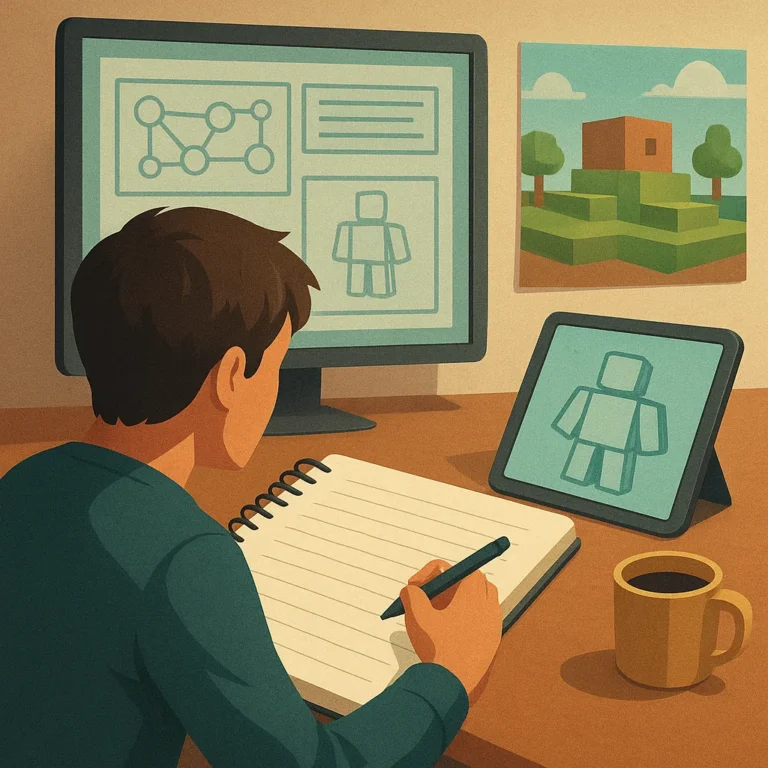
Test the cycle without building a map. Sketch each step on paper, describe the player decision, and predict the feedback that should follow. You can ask a friend to act through the sequence using your notes. Confusion at this stage is evidence, because revisions cost less before code and assets exist.
Choose a Manageable First Release
Choose a small first release that proves the central idea without demanding a complete universe. Limit the map, player abilities, enemies, currencies, and menus to what the loop truly needs. A smaller launch gives you something testable sooner, reveals real problems, and leaves room for improvements based on player behavior.
Set a finish line you can explain in one breath. Perhaps the release includes one area, one challenge, one progression track, and a session goal. This boundary is not a lack of ambition. It is a promise to complete the foundation, learn from players, and earn the confidence to expand wisely.
List Essential Features and Stretch Goals
Create two lists before development grows complicated. Essential features directly support the player promise or make the core loop understandable, safe, and repeatable. Stretch goals may improve variety, presentation, or long term depth, but they must not control the launch date. Labeling both lists makes tradeoffs visible when time becomes limited.
Rank essential features by dependency, player value, and testing difficulty. Build the pieces that unlock other pieces first, then validate the important experience before polishing minor details. When a task feels attractive but cannot be connected to the promise, move it aside. Your backlog should protect focus, not record every idea.
Separate Essential Features from Visual Polish
Mark polish separately from functionality so ambition does not hide missing play. A beautiful interface cannot rescue unclear goals, unreliable controls, or empty progression. Finish a version of each essential feature, then improve its presentation after testing. This order turns feedback into evidence instead of speculation about what players might enjoy.
Create a Testing and Update Schedule
Decide when testing will happen before your first build becomes complicated. Schedule short sessions with people who match your target player, and give them tasks rather than explanations. Watch where they hesitate, what they ignore, and what they repeat. Their behavior reveals design problems that enthusiastic verbal feedback fails to mention.
Keep a test record with the build date, participant type, observed obstacle, and planned response. Separate facts from guesses: a player missing a button is evidence, while your theory about the reason is a hypothesis. Review notes after each session, choose one or two changes, and test those changes again.
Plan updates around learning milestones instead of feature growth. After each release, ask whether players understand the goal, enjoy the loop, and see a reason to return. Share improvements, remove broken distractions, and preserve reliable systems. A steady cycle of observe, improve, and verify builds trust while keeping development manageable.