
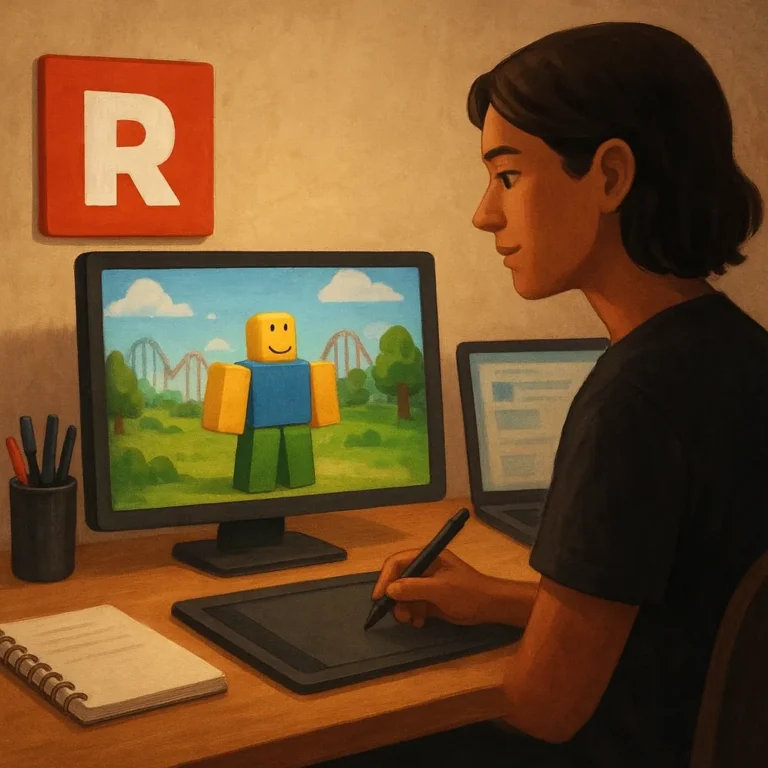
Your Roblox games can feel connected before a player reads your username. A clear creator identity comes from repeated choices: the kinds of experiences you make, the problems you solve, the tone you use, and the care you show after launch. It should clarify your work, not inflate it with promises.
Players notice patterns before they describe them as branding. They remember an interface, a color relationship, a respectful update, or a game that delivers on its idea. By building those patterns deliberately, you can make each release easier to recognize while allowing each project to remain distinct and useful to its audience.
Choose a Clear Creative Focus
Start by naming the territory you want to explore, even if it remains broad. You might favor cooperative challenges, quiet world building, compact social spaces, or playful systems with visual hooks. This choice is not a permanent label; it is a practical filter for deciding which ideas deserve your time and attention.
A useful focus also explains what you will not make right now. Without that boundary, a creator can chase popular formats and produce disconnected experiments that are difficult to remember. Review your strongest prototypes, note the decisions that recur, and describe the shared player experience in one plain sentence for reference.
Make the Brand Visible
Build a Repeatable Visual Language
Translate the focus into choices that players can encounter repeatedly. Select a restrained color palette, several dependable shapes, and an interface rhythm that suits your games. Consistency does not require identical screens or copied assets. It means the same underlying care appears in menus, thumbnails, icons, environments, and moments of feedback.
Choose typography and image treatments that remain readable on the devices your audience uses. Test them inside game pages, update notes, thumbnails, and community posts rather than judging a board alone. A visual system earns trust when it improves recognition without making information harder to find or a game harder to play.
Keep the Editorial Voice Steady
Your editorial voice should sound like the person or small team making the games. Use direct explanations, acknowledge uncertainty, and avoid language that suggests guaranteed popularity, effortless rewards, or universal appeal. Calm confidence is more credible than excitement, especially when players are deciding whether your next project deserves attention.
Keep the voice recognizable across announcements, support replies, store descriptions, and in-game guidance. That does not mean repeating one slogan everywhere. Instead, preserve a few behaviors: explain changes plainly, answer criticism without defensiveness, credit collaborators, and state limits before players have to discover them through frustration.
Communicate With Players
Communication is part of the product, not a separate performance around it. Before publishing an update, identify what changed, why, and what players should do next. If a feature is experimental, call it experimental. Clear framing lets people form reasonable expectations and gives you room to improve.
When you make a mistake, describe the impact before defending the intention. Tell players what you know, what remains uncertain, and when you will provide another update. A sincere correction may not satisfy everyone, but it shows that feedback reaches a real decision process rather than disappearing behind polished language.
Share Progress With Purpose
Development updates can deepen connection when they reveal useful work rather than manufacture suspense. Show a brief design question, a playtest lesson, or a meaningful revision. Explain the choice in enough detail for players to understand the direction, while protecting unfinished ideas that could change before release.
Choose a repeatable format for progress posts so communication remains manageable. A short clip can show a mechanic, a comparison can explain a visual revision, and a checklist can clarify a testing phase. Share only what you can discuss honestly; frequent small notes are stronger than dramatic teasers you cannot support.
Let Quality Lead
Let the games carry the most persuasive part of the identity: the player experience. Set a small quality bar for controls, onboarding, performance, accessibility, and basic stability. You do not need a flawless launch, but you should know which rough edges are acceptable for testing and which ones undermine the central promise.
Use player behavior as evidence, not as a vanity score. Watch where new users pause, leave, return, or ask for help, then connect those observations to specific design decisions. Feedback becomes valuable when it changes the work. Record recurring patterns, test one response at a time, and share lessons without exposing private player details.
Turn One Game Into a Connected Identity
A creator identity can connect several games without making them feel interchangeable. Let each project have its own setting, mechanic, and emotional pace, then carry one or two recognizable principles across the collection. Players may enter through a single experience, yet they can understand the relationship when the shared choices are purposeful.
Protect that identity from becoming a rigid formula. Review it after each release and ask which choices helped players, which slowed them down, and which no longer fit your direction. Refresh colors, formats, or language when needed, while keeping the underlying standards of honesty, usefulness, and care visible.